Valorant Champions Shanghai, what Day 8 of the group stage decided
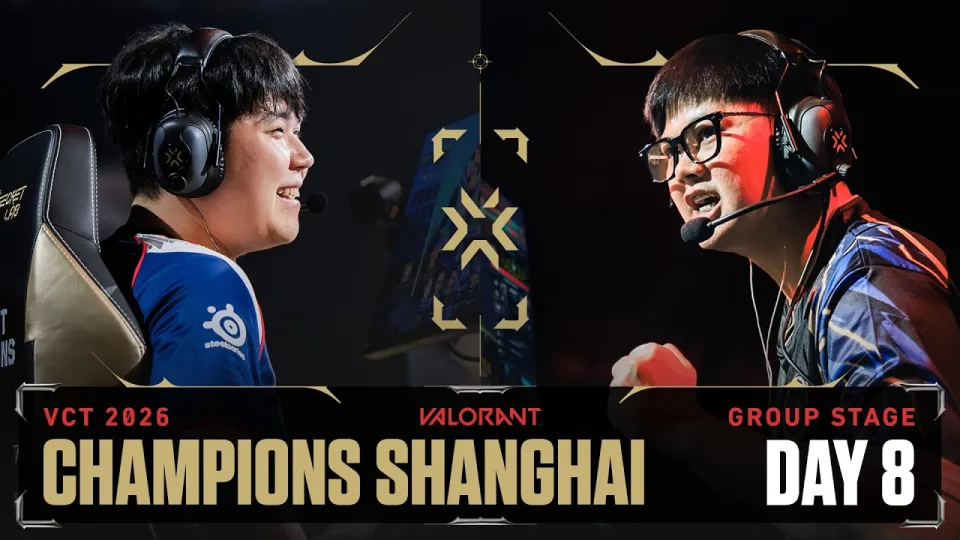
Video: VALORANT Champions Shanghai — Group Stage — Day 8
Need articles like this for your video? They help promote it on YouTube and Google — order them in the Telegram bot @sat_sit_bot. It writes articles around your video, embeds the video and publishes them on popular niche websites (no ads). Try it free: 50 articles on us.
· based on the channel VALORANT Champions Tour
Valorant is Riot Games' 5v5 tactical shooter in which two teams of five pick Agents with distinct abilities and fight over a spike, a bomb that attackers plant and defenders retake across 13-round halves. At the top level it is played through the VALORANT Champions Tour, and the biggest event on that calendar is Champions, the season-ending world championship. The 2026 edition lands in Shanghai, running from September 24 to October 18, with sixteen teams from the Americas, CN, EMEA and Pacific fighting for a single trophy. Day 8 of the group stage, published by the VALORANT Champions Tour channel, is where the regional picture finally sharpened — and where the host region's hopes ended. For schedules, bracket updates and announcements around the event, the official esports account at VALORANT Esports on X is the fastest source.
What Valorant Champions Shanghai is and who plays in it
Champions is the closing tournament of the VCT season and the only event that crowns a world champion. Sixteen teams qualify through their regional leagues and international events across four territories: Americas, CN, EMEA and Pacific. The format opens with a group stage, where teams are split into groups and play a round-robin or double-elimination style block to determine who advances, followed by a playoff bracket that runs to a single grand final. Shanghai hosts the whole thing, which matters more than usual: a home crowd changes the pressure on CN squads, and the event's production has leaned into the city itself, from venue aesthetics to the on-air presentation. The 2026 season also arrived with unusual context, since two Masters events had already produced new champions, breaking the assumption that the same handful of organizations would keep trading titles.
Day 8: T1 vs JD Gaming and the shape of the group stage
The eighth day of the group stage was built around the T1 versus JD Gaming series, with the broadcast also carrying earlier games before it. A full day of Champions group play is long — three maps can stretch past four hours of airtime, and the stream included a technical pause in the middle of the block, a reminder that even Riot's flagship events deal with server and setup interruptions. T1 came in as the more established international side; JD Gaming came in as the CN representative with something to prove on home soil. The series went the distance, and the third map is where the story turned, with JD Gaming unable to keep the level they had shown earlier in the match. For viewers who want the raw broadcast rather than a summary, the full Day 8 VOD is available on the VALORANT Champions Tour channel.
The 11-6 lead that never became a map win
The single most consequential moment of Day 8 was not a clutch or an ace; it was a lead that evaporated. JD Gaming built a 11-6 advantage on the opening map, a position that in professional Valorant usually converts into a win — teams at this level close out six-round cushions the vast majority of the time. Instead, T1 clawed the map back round by round, forced overtime territory, and took it. The swing mattered beyond one map: it drained JD Gaming's economy of confidence, and the rest of the series reflected that. In a group stage where map differential can decide seeding, losing a map you led 11-6 is close to the worst possible outcome. Viewers flagged it immediately as the moment the series slipped, and the third map confirmed it.
Why every CN team exited before the playoffs
All four Chinese representatives were eliminated during the group stage, a result that dominated discussion around Day 8. The reasons stack up in layers:
- Preparation gap. CN teams entered the international season with less cross-regional practice against Americas and EMEA styles, and it showed in mid-round decision-making rather than raw aim.
- Home pressure. Playing a world championship in your own city amplifies every mistake; several CN squads looked tighter in close rounds than they had in regional play.
- Map pool depth. Best-of-three series punish teams with two comfortable maps, and the CN sides repeatedly ran into opponents who could ban away their strongest pick.
- Bracket luck. Facing an established Pacific or EMEA seed early in the group stage leaves almost no room to recover from a single bad map.
The counterargument that CN slots should be cut or merged back into Pacific ignores how recently the region has been competing at this level. Regional strength is not static, and the same criticism was aimed at other regions before they broke through.
Agent picks, role swaps and the details viewers noticed
T1's decision to put Munchkin on a duelist was one of the most discussed choices of the day, and it reflects a broader trend in professional Valorant: flexibility over specialization. Duelists are the entry-fraggers, the Agents designed to take space and open sites, and moving a player with a different background into that role changes how a team executes. It can unlock aggressive defaults, but it also puts a player into duels they would not normally take. Elsewhere, the broadcast's quieter moments drew attention too — a crowd described as library-quiet at points, a silenced Crown ultimate that viewers found satisfying, and a hit-registration complaint about an Omen shot that appeared to show fewer bullet impacts than the shooter expected. Those debates are part of watching live tactical shooters: at 128-tick servers and LAN conditions, perception and server truth still occasionally diverge.
What the bracket demands from here
Advancing from the group stage is only the first filter. In the playoff bracket, teams face single-elimination pressure with no second chances, and the map veto becomes a chess match rather than a formality. Teams that survived Day 8 need three things: a deep enough map pool to survive a targeted ban, a reliable second caller so mid-round adjustments do not stall, and a retake protocol that holds up when the opponent has full utility. T1 showed the second and third of those in the comeback against JD Gaming. The teams that looked strongest in the group stage are not automatically the favorites in a bracket — historically, Champions has been won by squads that peaked in the playoff weeks rather than the group weeks.
Useful links
- Official esports updates: https://x.com/valorantesports
- Facebook: https://www.facebook.com/ValorantEsports/
- Instagram: https://www.instagram.com/valorantesports/
- TikTok: https://www.tiktok.com/@valorantesports
- Twitch: https://www.twitch.tv/valorant
- News and event hub: https://www.valorantesports.com/news
The takeaway from Shanghai's group stage
Day 8 of Valorant Champions Shanghai turned a regional storyline into a definitive one: T1's comeback from 11-6 down eliminated JD Gaming, and with that result every CN team was out before the playoffs. The tournament is still wide open, because the 2026 season has already shown that established hierarchies do not hold — two Masters titles went to new champions, and the group stage produced more upsets than predictable results. What remains is a bracket where map pool depth and mid-round discipline will separate the final four from the rest. For continuing coverage, bracket updates and full VODs of every series, follow the VALORANT Champions Tour channel and check https://x.com/valorantesports for official announcements as the playoffs unfold.
Key takeaways
- Valorant Champions Shanghai runs September 24 to October 18 with 16 teams from Americas, CN, EMEA and Pacific.
- Day 8 featured T1 vs JD Gaming as the headline series of the group stage block.
- All four Chinese representatives were eliminated before the playoff bracket filled out.
- JD Gaming led 11-6 on the opening map and lost it, a swing that decided the series.
- T1 moved Munchkin onto a duelist, a role swap that drew immediate attention from viewers.
Questions & answers
Did any Chinese team make it out of the Valorant Champions Shanghai group stage?
No. All four CN representatives were eliminated during the group stage, including JD Gaming after their series loss to T1 on Day 8. The result sparked debate about whether the region's slots should be reduced or merged back into Pacific, though CN teams have only recently begun competing at this level internationally.
How did JD Gaming lose a map they were leading 11-6?
They failed to close out the opening map, and T1 took it instead. At professional level an 11-6 lead usually converts, so the loss compounded into a confidence and economy problem for the rest of the series. JD Gaming then dropped the deciding third map, ending their tournament.
Why was Munchkin playing a duelist for T1?
T1 moved Munchkin onto a duelist as a role-flexibility experiment, which viewers noted immediately. Duelists are the entry-fraggers who take space and open sites, so putting a player with a different role history there changes how the team executes its defaults and site takes.
Are hit-registration complaints like the Omen shot a real problem in Valorant?
Occasional disagreements between what a player sees and what the server registers happen even on LAN, and viewers flagged one such moment during Day 8. These are usually isolated rather than systemic, but they generate discussion because single bullets decide rounds in tactical shooters.
Source: VALORANT Champions Shanghai — Group Stage — Day 8 · Markdown version